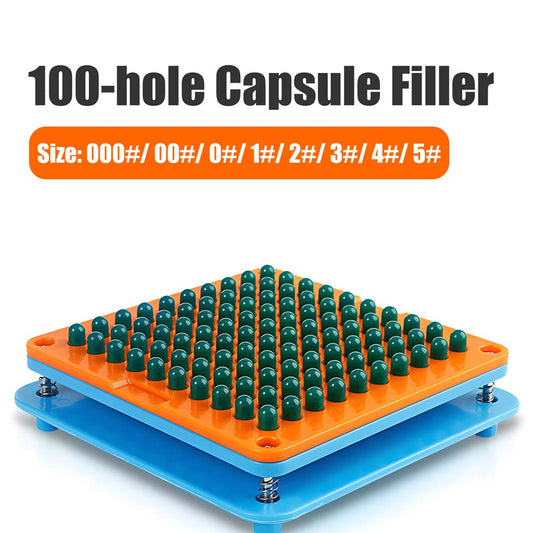
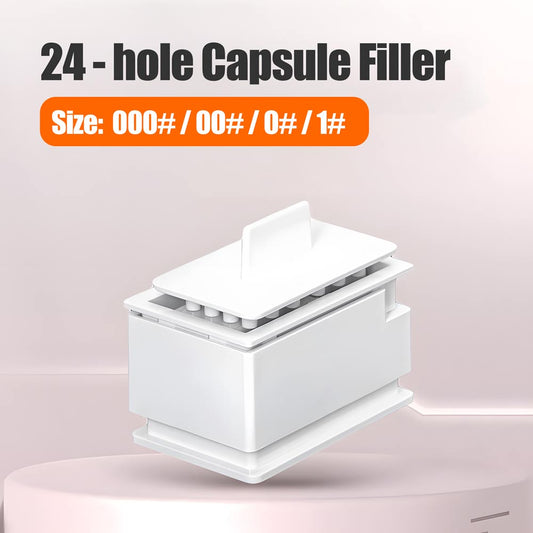
Why Won't My Capsules Close? A Manual Capsule Filler Troubleshooting Guide
If you've ever tried to close a capsule and found that the cap won't fit, the shell cracks, or the two halves won't line up, you know how frustrating it can be.
The good news is that you can often narrow down the possible cause with a few simple checks.
Before applying more pressure, stop and inspect the capsule and filling tool. A size mismatch, uneven seating, damaged shell, or alignment issue may be involved.
This guide walks through a practical troubleshooting process for manual capsule filling tools.

1. Check Your Capsule Size First
Not all empty capsules are the same size.
Common capsule sizes include 000, 00, 0, 1, 2, 3, 4, and 5. Different sizes have different dimensions, and a filling tool must be designed to accommodate the specific capsule size you're using.
What to check:
- Read the size printed on your empty capsule packaging.
- Check the exact size designation of your filling tool or tray.
- Confirm that the tool's specific variant supports that capsule size.
- Don't assume two similar-looking capsules are interchangeable.
Some filling tools support one specific size, while others are offered in multiple size-specific versions.
If you can't confirm compatibility, stop and check the manufacturer's specifications before continuing.
2. Inspect the Empty Capsule Shells
Sometimes the problem may involve the capsule shell rather than the filling tool.
Before attempting another closure, inspect a few unused capsules.
Look for:
- Visible cracks or splits
- Bent or deformed capsule bodies
- Damaged capsule caps
- Unusual brittleness
- Moisture or visible changes in shell condition
Set aside any damaged or questionable shells.
Capsule condition can be affected by storage and handling, but the appearance of a damaged shell alone does not establish its cause. Follow the capsule manufacturer's storage instructions.
3. Check Capsule Seating and Alignment
A capsule may be difficult to close when its cap and body are not aligned properly.
Possible issues include uneven seating, a shifted component, or a capsule that isn't positioned as intended for the tool.
Try this basic check:
- Stop using the tool if a capsule cracks or closure requires unusual force.
- Check that the tool components are correctly assembled according to the manufacturer's instructions.
- Inspect the contact areas for visible debris or damage.
- Place one undamaged, empty capsule in the tool as instructed.
- Observe whether the cap and body appear aligned before attempting normal closure.
Do not force the capsule into place.
If alignment remains uncertain, refer to the tool manufacturer's instructions rather than improvising adjustments.
4. Identify the Problem Before Trying Again
Use this quick reference table to decide what to inspect next.
| What you notice | What to check first |
|---|---|
| Capsule cap won't fit | Capsule size and cap/body pairing |
| Capsule shell cracks | Shell condition, seating, and excessive force |
| Capsule halves appear misaligned | Tool assembly and capsule positioning |
| Several capsules fail in the same position | Visible damage or obstruction at that position |
| Closure becomes unusually difficult | Tool condition, compatibility, and manufacturer instructions |
| Different capsule batches behave differently | Capsule brand, size, lot, and storage instructions |
These are inspection suggestions, not confirmed diagnoses. The same symptom can have more than one cause.
5. Avoid Forcing the Capsule Closed
When a capsule won't close, applying more pressure may seem like the easiest solution.
However, excessive force can damage capsule shells or tool components.
Avoid:
- Striking or hammering the filling tool
- Adding uncontrolled weight
- Heating or reshaping components
- Enlarging holes or modifying alignment parts
- Applying unapproved lubricants or solvents
If normal operation requires unusual force, stop and investigate the cause.
Do not attempt to repair damaged components through improvised modifications.

6. Test with a Small Number of Empty Capsules
After checking the capsule size, shell condition, and tool alignment, you can perform a limited check using a small number of undamaged, empty capsules, following the manufacturer's instructions.
Keep the test simple:
- Use capsules of a confirmed compatible size.
- Inspect each shell before use.
- Follow the normal operating instructions.
- Stop immediately if cracking, misalignment, or excessive resistance occurs.
If the problem continues, don't repeatedly force the tool.
Instead, record the details and contact the capsule or filling-tool supplier.
7. Keep a Simple Troubleshooting Record
A short record can make it easier to describe a recurring problem to the supplier.
Useful details include:
- Filling tool model or variant
- Capsule size
- Capsule brand
- Capsule batch or lot number, if available
- The exact problem observed
- Whether the problem occurs in one position or multiple positions
Photos of the damaged shell and tool setup may also help the supplier understand the issue.
Frequently Asked Questions
Why do my empty capsule shells keep cracking?
Cracking may be associated with shell condition, handling, alignment, or excessive force. Inspect the shells, verify size compatibility, and follow the manufacturer's instructions. The visible crack alone does not identify the cause.
Can I use different capsule sizes in the same filling tray?
Only if the manufacturer explicitly confirms that the specific tool or configuration supports those sizes. Do not assume a tray is universal.
Should I press harder if the capsule won't close?
No. Stop if normal closure requires unusual force. Check compatibility, shell condition, and alignment instead.
What if the same problem happens repeatedly?
Stop using the affected setup and document the tool model, capsule size, shell brand, and observed failure. Contact the appropriate supplier for guidance.
Final Thoughts
Capsule closing problems are easier to investigate when you check one factor at a time.
Start with size compatibility, inspect the capsule shells, verify tool alignment, and avoid excessive force.
A careful inspection process can help you describe the issue more clearly and decide when to seek manufacturer support.
Important: This guide provides general mechanical troubleshooting information. It does not establish compatibility with a particular capsule brand or tool, validate a manufacturing process, or replace product-specific instructions.